If an onboard arrangement appears different from the latest known fire control plan, the first job is to document what is observed accurately. A reviewer should not quietly edit a PDF and treat it as the updated controlled plan. The responsible design party must evaluate the information and prepare a technical revision, while the vessel's responsible parties determine which formal requirements apply.
The IMO-published SOLAS amendment text describes keeping applicable fire-control plans/booklets up to date and recording alterations as soon as practicable. That source does not answer every vessel-specific approval question. Check the applicable regime with the responsible maritime parties.
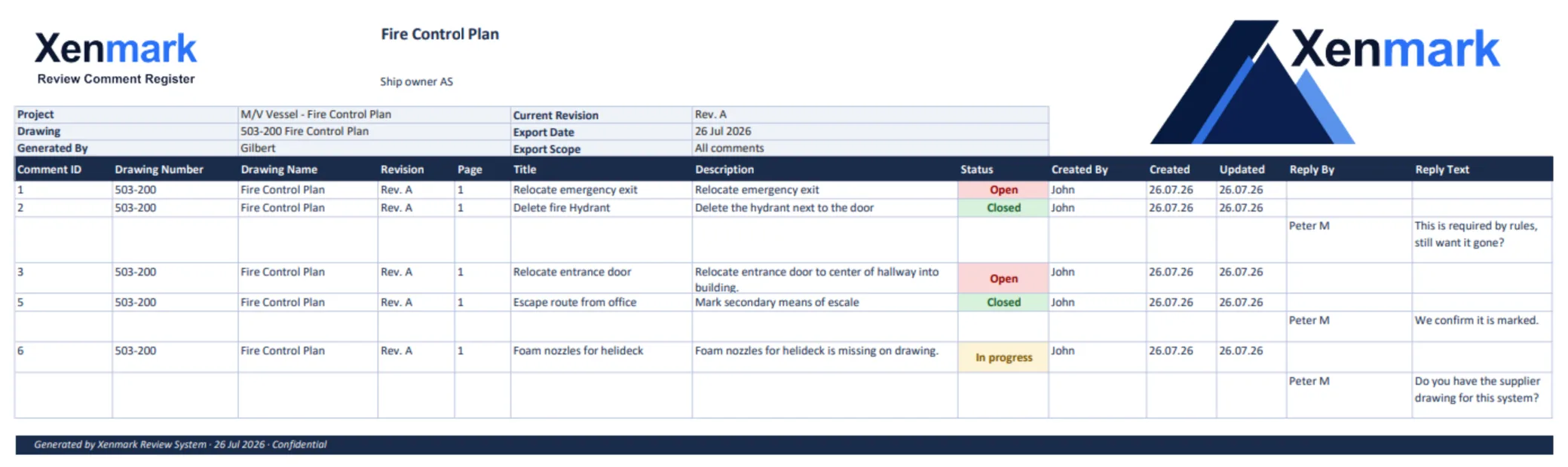
Step 1: establish the plan you are comparing
Record the plan’s number, title, revision and issue date from the latest known controlled copy. Note where the copy came from and whether its status is confirmed. If the vessel has more than one relevant plan sheet or booklet, identify the exact deck and sheet. This avoids a request built on an obsolete or ambiguous reference.
Step 2: record each observed difference separately
Locate the item on the plan and describe the observed condition onboard. Useful context may include deck, compartment, nearby feature, equipment label, photograph and date of observation. Keep “the plan shows X” separate from “onboard we observe Y”. Add a question for the responsible party: verify, assess, revise or request further survey information.
Illustrative example: A plan depicts a piece of firefighting equipment beside one access point, while a vessel-side photograph shows an apparently matching item beside another. The reviewer pins a comment at the plan location, identifies the deck/space, and asks the responsible party to verify the equipment and plan information. The reviewer does not independently decide which symbol or formal submission is required.
Step 3: provide context for the technical reviewer
An engineer or plan author may need to know whether the item was moved, replaced, relabeled or merely mistaken for another one. Include any work order or equipment information that the owner is permitted to share. If photographs are incomplete or the item identity is uncertain, say so. A clear statement of uncertainty is safer than an apparently precise but unsupported instruction.
If the concern involves graphical symbols, use the applicable source rather than an improvised legend. Graphical symbols for the fire control plan follow IMO Resolution A.952(23), supplemented as applicable by IMO Resolution A.1116(30): IMO’s FAQ explains that table 3 of A.1116(30) is used where A.952(23) has no symbol for an item, and that which instrument applies depends on the ship’s construction or modification date. The responsible specialist decides how those instruments apply to a particular vessel.
Step 4: let the appointed party prepare the revision
The responsible engineering or design party interprets the observations and makes changes in its controlled authoring process. It may request further onboard confirmation or determine that related drawings need checking. The vessel-side team should be available to answer those questions and verify the observed facts; it should not present a marked-up PDF as the final approved plan.
Step 5: review the returned PDF
Confirm the returned plan number and revision. Check each earlier observation against the new issue. Then inspect nearby context for newly introduced questions. Keep earlier comments with their original revision and record the team’s judgement on the new one. A comment marked Closed in a review tool is not evidence that a plan has passed a separate formal approval.
Step 6: complete any applicable formal process and retain records
The vessel’s responsible parties determine whether class, flag, statutory or other submission/approval steps apply, and use the appropriate channel. Retain the issued plan, observations, replies, revised PDF and review record in the owner’s controlled system. Xenmark can help coordinate PDF review around that process; it does not replace it.
A one-page discrepancy card—plan ID, deck/space, observed condition, source photo, uncertainty, requested technical check, returned revision and reviewer outcome—can make this workflow repeatable. For the product review layer, see Fire Control Plan Review. For the general vessel drawing-update path, see Vessel Drawing Updates.
What should the discrepancy card actually say?
Use a neutral record rather than a conclusion disguised as an observation. For example:
| Field | Illustrative entry |
|---|---|
| Plan reference | FCP-01, Rev C, Deck 2, source to be confirmed |
| Location on plan | Access space adjacent to equipment room |
| Observed condition | Equipment appears at a different marked position onboard |
| Evidence | Photograph dated 12 May; item identity not yet verified |
| Question | Please verify equipment identity and advise whether the controlled plan requires revision |
| Responsible follow-up | Vessel contact to confirm tag; appointed plan author to assess |
| Returned issue | To be entered when an issued revision is received |
These entries are illustrative. They demonstrate how to preserve uncertainty rather than imply that a vessel-side reviewer has already determined the technical or regulatory answer.
What if the current onboard plan and shore copy differ?
Record both document identities, where each copy was found, and which one the owner regards as controlled. Do not merge their annotations or assume the one with a later-looking filename is authoritative. The discrepancy may be in the onboard archive, the shore archive, the plan itself or the team’s understanding of the revision. Bring the owner’s document controller or responsible party into the review before declaring a technical update complete.
What should a reviewer avoid saying?
Avoid blanket claims such as “this change always requires class approval,” “the vessel is compliant because the comment is Closed,” or “all plans must use the same symbol set.” The IMO sources have specific scope and dates, and a particular vessel may have additional flag or class requirements. State the observed facts, cite the source being relied on, and direct the applicability decision to the responsible specialist. A guide can teach a careful process without pretending to be the vessel’s approval authority.
For US-specific examples, the USCG fire-control-plan review guide discusses legibility and consistency with other plans, while explicitly saying it is not itself a rule. That is a useful illustration of why source scope and disclaimers should stay visible. It should not be transplanted into a universal checklist for every flag.
Who should sign off each part of the work?
The person who observes an onboard difference can confirm what was seen. The responsible plan author can confirm what was technically revised and why. The vessel owner or document controller can confirm which issued plan is now held as the controlled copy. A class society or authority, where its review applies, communicates its own formal decision through its own channel. Naming those separate confirmations prevents a single “done” tick box from obscuring an incomplete step.
If a reviewer cannot identify who owns a step, record that as an open question. The workflow is complete when the correct parties have made the relevant decisions and the issued record can be traced—not when a PDF has simply been marked up.
When a formal decision is pending, do not describe the new PDF as “approved” merely because a plan author has issued it. Say exactly what has happened: “revised PDF issued for review,” “owner review completed,” or “formal decision pending,” as the evidence permits.
Outside sources on this page were checked on 23 September 2026.
Related pages
Return to Maritime & Shipbuilding for the Industry hub. Fire Control Plan Review shows the product review layer, and Vessel Drawing Updates shows the wider vessel-to-engineer handoff. Ship Owners, Superintendents / Technical Managers and Marine Engineering Companies describe the relevant participants.