An internal review can help a project team clarify its own drawing questions before a formal classification-society submission. It is not the class review itself. The responsible party still submits through the applicable class process and answers the official comments there.
The most useful preparation is straightforward: confirm the drawing identity, bring the right internal reviewers to the issued file, make open questions visible, and decide under the project's own procedure what is ready for the next step.
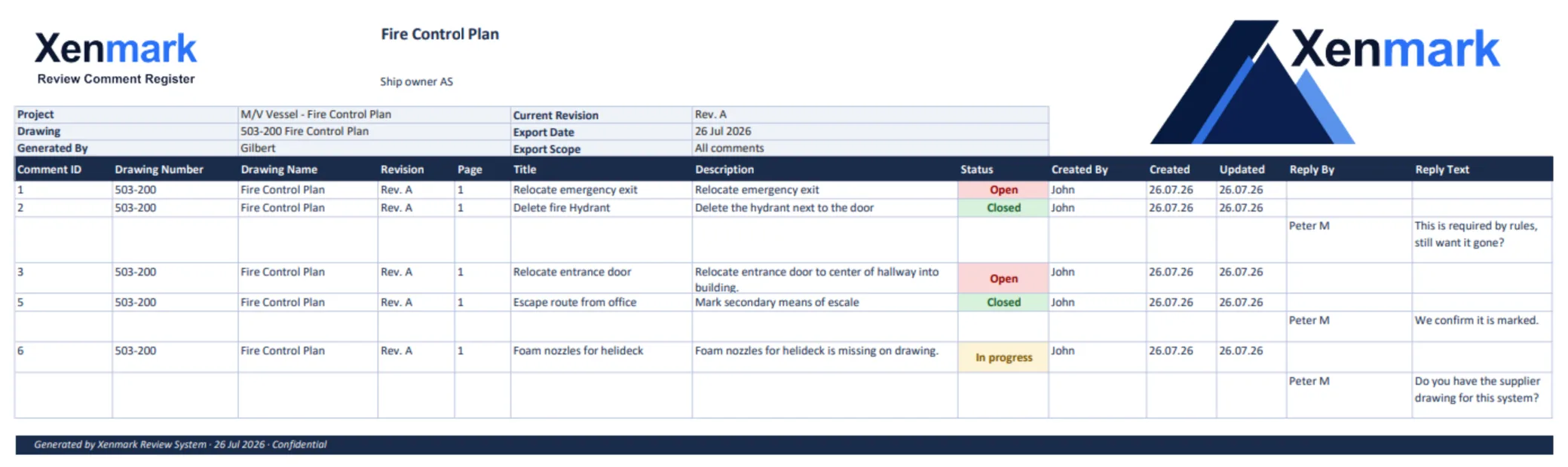
Confirm what is being reviewed
Record the drawing number, title, revision, issue date and intended submission package. Check the project’s own document register or transmittal, where available, rather than relying on a convenient filename. Identify any related drawings or supplier files that are needed to understand a point. An internal review can be undermined if one participant is commenting on Rev B while another assumes Rev C.
Gather the right internal questions
The design lead, owner representative, yard, discipline specialist or supplier may each have a legitimate question. Invite people because their knowledge matters to this drawing, not because every available stakeholder must approve everything. Ask reviewers to place comments at exact drawing locations and say whether the point is an observation, a request for clarification or a proposed change.
Illustrative example: Before a machinery drawing package is submitted, the owner asks whether a service access route is represented correctly; the yard raises an installation interface; the engineering lead replies to both. The project may decide that one item needs a new issue before submission and another can be documented under its own agreed process. This example is not class guidance or a claim about a real project.
Make unresolved points visible
The project determines whether an internal issue must be resolved before submission. There is no safe blanket rule that every internal comment must be Closed. Record who owns each open point, what evidence is missing, and what decision is needed. A Xenmark status of Open, In progress or Closed describes only the internal review item, not the class society’s formal judgement.
A simple internal worksheet can contain:
| Field | Question it answers |
|---|---|
| Drawing ID and revision | Which issued file was internally reviewed? |
| Reviewer and scope | Who checked which part? |
| Open point and owner | What still needs a decision? |
| Supporting evidence | What is the basis for the point? |
| Submission decision under project process | What did the responsible project party decide next? |
This is an internal coordination aid, not a universal class pre-submission checklist.
Keep the formal class channel separate
After the internal team completes its agreed review, the appointed party uses the relevant classification society’s submission system. For example, DNV describes plan approval and its eApproval channel, while DNV’s portal help covers document numbers/revisions and official approval comments. Other societies and projects may differ. Xenmark does not submit drawings for class, issue stamped drawings or determine compliance.
If official class comments come back and the project team needs to coordinate an internal response, retain the official comment and answer in the class channel. A shared PDF review can help the internal team discuss the returned drawing or required revision, but it should never make an internal comment look like an official class decision.
Review the revised drawing before the next handoff
Confirm the new drawing revision, inspect whether internal questions were addressed and look for new issues. Earlier review comments remain on their original PDF; reviewers judge the new issue themselves. Keep the internal review record with the project’s document-control files so someone can understand why a drawing was advanced or returned.
For the product-facing workflow, see Review Ship Drawings Before Class Submission. The global Internal Drawing Review Use Case explains the sector-neutral process.
A practical internal-review handoff
Before the formal submitter takes over, prepare a short handoff summary that identifies the issued drawing package, who performed the internal review, which comments were answered, which remain open and how the responsible project party decided to treat them. Reference any supporting document rather than embedding a private or controlled file into an unrelated review export. The summary helps a future participant understand why the package advanced; it does not certify that the package meets class requirements.
For the illustrative machinery package, the handoff might say that the owner access question was answered on Rev C, the supplier service-envelope reference is V-07 Rev 2, and the yard installation interface requires a final answer from the design lead. The design lead then decides whether the drawing should be revised before submission under the project’s process. This is a possible internal sequence, not advice from a class society.
How should official comments be treated when they return?
Identify the issuing society and the official comment reference. Keep the official status and reply in that society’s process. If the project team discusses the impact internally, cross-reference the official point without relabeling an internal note as a class comment. The designer may need to revise a drawing, the owner may need to confirm an operational issue, and the yard may need to assess installation impact. Those conversations can be coordinated around an issued PDF, but the formal response remains with the appointed party in the official channel.
Do not assume DNV’s labels or portal steps apply to another society. DNV’s documentation shows how much formal document and comment handling already exists outside Xenmark. Keep the internal review distinct from that formal process.
Before treating the internal review as complete
Check that the drawing number and revision match the planned package, that every invited reviewer worked on the intended issue, that open points have an owner and decision, that replies reference real evidence or a revised drawing, and that the internal export has an issue date. These checks improve coordination even if the project ultimately uses a different review tool. They do not predict or guarantee formal class approval.
Maintain the worksheet as a project record with appropriate access. When using it to train another team, remove client names and controlled approval documents or use clearly labeled illustrative entries. The distinction between internal review and formal class comments must remain visible even in a simplified example.
If a project uses several class societies or multiple flag requirements across a fleet, keep the same boundary: identify the internal review task and use the applicable formal process for the specific vessel. A generic “class-ready” badge cannot express every society’s actual decision.
Related pages
Return to Maritime & Shipbuilding for the Industry hub. Review Ship Drawings Before Class Submission covers the product-facing internal review; Ship Drawing Review & Markup covers the underlying PDF discussion. The global Internal Drawing Review Use Case explains the generic process. Ship Owners, Shipyards and Marine Engineering Companies are the relevant Teams.