A redline can be the fastest way to point at a ship drawing and say, “This is where the vessel differs.” A comment register is better at preserving what was asked, who replied and what happened on the next revision. Many projects benefit from both: a clear visual mark and an organized record of the conversation around it.
Neither method is inherently obsolete. Choose based on the number of people, issues and revision rounds—not on whether one format looks more modern.
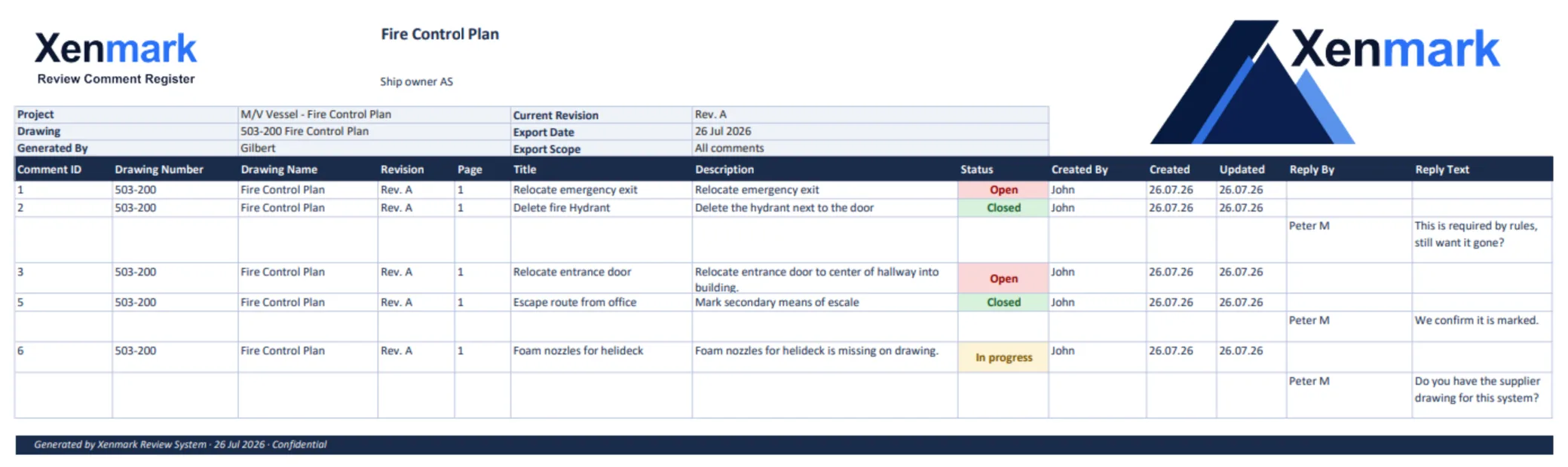
What does a redline do well?
A redline—hand markup or digital annotation—communicates spatial information quickly. An arrow, cloud or short note can show the area of concern on an issued PDF. For one observer and one clearly understood correction, that may be enough to begin a conversation.
Its weakness appears when context is lost. “Valve here” may leave the engineer asking which valve, which drawing issue, whether the arrow describes current onboard condition or a proposed design, and who is responsible for confirming it.
What does a structured register add?
A numbered review point can link the marked location to a row containing the drawing/revision, exact question, supporting evidence, person who raised it, reply, owner, status and later-round outcome. The visual clue stays valuable; the register gives it a stable identity and history. A spreadsheet can serve that purpose if maintained carefully. A shared PDF-review tool can connect the drawing pin and conversation directly.
Illustrative comparison, same issue: On drawing M-104 Rev A, a reviewer draws an arrow from pump P-2 to an observed alternate location and writes “pump here.” That is a useful starting redline. In the structured version, point C-01 at P-2 says: “Current vessel photograph dated 12 May shows the replacement pump aft of the foundation; this issue depicts it forward. Please verify the installed arrangement and advise whether the drawing requires revision.” The engineer requests a nameplate and connection photograph; the owner supplies them. When Rev B arrives, the reviewer checks the pump location and records the outcome. This scenario is illustrative, not a customer case.
| Review question | Redline alone | Redline plus structured point |
|---|---|---|
| Where is the concern? | Usually clear visually | Clear visually and by item ID |
| Why was it raised? | Depends on note detail | Stored in the point text and evidence |
| Who replied? | May require a separate email | Reply attached to the point |
| What happened on Rev B? | Must be reconstructed manually | Human conclusion can be recorded against stable ID and revision |
The table describes a typical comparison, not a claim that every spreadsheet or redline is poorly managed. A disciplined team can attach notes and history to either method.
When should the team add structure?
Use more structure when several organizations review the same drawing, when one drawing contains many points, when issues span multiple disciplines, or when the review will continue through several revisions. The goal is not to create paperwork. It is to prevent the same question from being raised repeatedly because its location, answer or status cannot be found.
Keep the original redline as evidence where it helps. Convert its question into one or more location-specific review items when replies and follow-up are needed. Distinguish an observed onboard condition from a proposed technical solution; the responsible design party decides what to author.
Xenmark can support the numbered PDF comment and reply process, with a matching review export. It does not make a redline into an approved technical change. For the broader workflow, see Vessel Drawing Updates. For register fields and maintenance, see How to Maintain a Ship Drawing Comment Register.
How does the comparison change over two revisions?
On Rev A, the redline points to an apparent pump-location difference. The numbered comment adds who observed it, a photograph reference and the engineer’s request for more information. On Rev B, the pump symbol is moved, but the reviewer still has to check the connection and access. A redline on Rev A cannot simply be overlaid on Rev B and called “closed.” The structured record can preserve C-01 on Rev A, record the human conclusion about Rev B, and create a new Rev B point if the connection needs attention.
The important improvement is not that a table exists. It is that someone reading months later can reconstruct the question, evidence, answer and issued drawing context. A disciplined redline package with a transmittal and response log can achieve much of that. A structured comment register is one practical way to make it repeatable when several people and drawing rounds are involved.
A fair choice by situation
Use a quick redline when the issue is simple, the drawing identity is known, one responder can answer and no long follow-up is expected. Add stable numbered points and a register when the review spans several organizations, the same question may receive multiple replies, or the next revision must be checked against the original. Keep both visual and tabular records when the location is hard to describe and the decision needs a clear history.
Do not assume that an Excel file is the master merely because it is easy to share. Decide who maintains the review record and how exported copies are reconciled. Likewise, do not assume a shared review tool makes comments authoritative: the responsible technical party still authors and checks the drawing, while the project decides what Closed means in its own review.
What should be captured from a paper redline?
If a crew member marks a printed drawing, preserve a photograph or scan with the source drawing number and revision. Translate the observation into a clear location-specific question, including uncertainty about the hand mark. Do not redraw it into the CAD/master file without the engineer’s technical assessment. The original visual note can remain valuable evidence, especially when it shows how the issue was first noticed.
The deciding question is whether the next person can connect the visual mark, the reply and the returned drawing without reconstructing an email trail. If the answer is yes, the process may already be sufficient. If the answer is no, stable identifiers and a shared register are likely to add practical value.
The same drawing issue illustrates both methods here. A redline remains useful after a numbered point is created because it can preserve the original visual observation that prompted the technical conversation. The register adds the reply, owner and revision outcome. Compare those roles without treating either method as universally sufficient.
Related pages
Return to Maritime & Shipbuilding for the Industry hub. Vessel Drawing Updates shows the full work sequence; Maritime Drawing Comment Register shows the product-facing register; and the global Drawing Comment Register & Review Deliverables Use Case explains the generic record. Ship Owners, Shipyards and Marine Engineering Companies show the participating Teams.